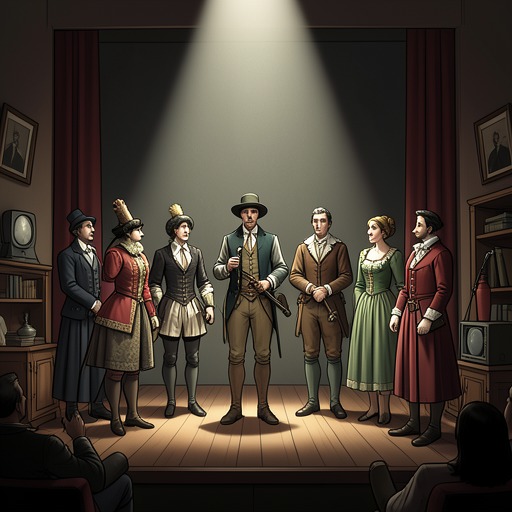
Natural drama and theatrical rules
The Blazing WorldNatural drama and theatrical rules names a debate about whether theatrical merit depends on formal convention or on representing human life persuasively. In the Blazing-World, the Duchess argues that plays can describe human characters, actions, and fortunes without following artificial rules; the Emperor’s wish for a theatre that makes wise people gives that defense a practical purpose, while the Empress’s taste for farce lets the Duchess imagine a distinctive theatrical form for the world.
The Theatre and the Duchess’s Advice
After viewing the Emperor’s magnificent buildings, the Duchess’s soul prepares to leave, but the Emperor asks her to advise him on establishing a theatre for plays. She admits that she knows little about constructing theatres or designing scenes, beyond what she observed immaterially in a theatre in the chief city of E. The Emperor and Empress nevertheless believe she can advise them about making plays, shifting the discussion from theatrical architecture to dramatic composition.
The Duchess initially says she has as little skill in composing a play according to the mode as she has in painting or making a scene for display. When the Empress points out that she has written plays, the Duchess distinguishes her intention from the judgment of contemporary critics: she meant her works to be plays, but the wits of her own time condemned them as unfit for performance because they did not follow the rules of art. She maintains that their descriptions are as good as those in the works the critics praise.
Natural Representation Versus Artificial Rules
The Emperor asks whether plays are meant to describe the varied humours, actions, and fortunes of mankind. The Duchess agrees. The Emperor then draws out the contradiction at the heart of the dispute: human dispositions, actions, and fortunes in nature do not themselves proceed according to the artificial rules imposed on plays. The Duchess answers that the method of her age’s wits is precisely to despise descriptions of character and experience that do not obey such rules.
The disagreement is not simply about technique. Asked whether methodically constructed plays are genuinely good, the Duchess says they are considered good according to the judgment and fashion of their age and nation, but not according to her own judgment. She contrasts an inherited critical standard with her assessment of what drama ought to do: a play’s conformity to convention may secure approval without making it wise or valuable.
Dramatic Purpose and the Blazing-World’s Stage
The Emperor makes his preference explicit: he wants a theatre that can make wise men and descriptions that are natural rather than artificial. The Duchess replies that her plays might be acted in the Blazing-World even though they cannot be acted in what she pointedly calls the “Blinking-World of Wit.” She promises to try to arrange the Emperor’s theatre on her next visit so that it can present plays suited to her abilities.
Her critique of fashionable drama sharpens into a contrast of educational purposes. She warns that plays praised by contemporary taste may become “a Nursery of whining Lovers,” rather than an academy or school for wise, witty, noble, and well-behaved men. The Emperor’s desired theatre, by contrast, is meant to form its audience. The exchange therefore treats dramatic form as consequential: what a society accepts as good theatre helps determine the habits and ideals its stage encourages.
Farce, Performance, and the Unfinished Plan
The Empress adds that she likes a foolish farce when it is joined to a wise play. The Duchess sees the Blazing-World’s inhabitants as especially suited to this comic mode, naming the Lice-men, Bird-men, Spider-men, Fox-men, Ape-men, and Satyrs as fitting performers for an unusually entertaining farce. Her suggestion connects the world’s varied peoples to theatrical spectacle without reducing the discussion to conventional stagecraft.
The Emperor and Empress ask the Duchess’s soul to remain until she has arranged the theatre and made plays and farces for them. She declines because she longs to return to her own world and be with her dear Lord and Husband, promising to visit again after a short time. Her departure leaves the theatrical project prospective rather than completed: the conversation establishes her artistic principles and an invitation to realize them, but the account does not show the theatre being built or her plays being performed.